Browse

Log in / Register
 Share
Share
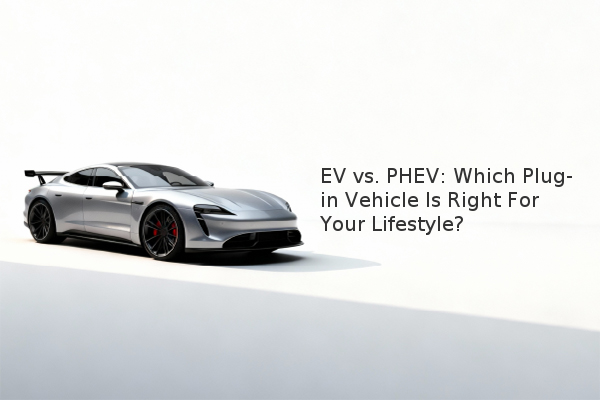
For most drivers, the choice between a fully electric vehicle (EV) and a plug-in hybrid electric vehicle (PHEV) hinges on a single factor: your daily driving habits and ability to charge at home. If you have consistent access to home charging and your daily commute is within an EV's range, a pure EV offers lower operating costs and zero emissions. However, if you take frequent long trips, lack reliable charging, or live in a very cold climate, a PHEV provides the electric driving benefits with the security of a gasoline engine.
A fully electric vehicle (EV), or battery-electric vehicle (BEV), is powered exclusively by a large battery pack and one or more electric motors. It has no gasoline engine, tailpipe, or emissions. The vehicle's range is determined by its battery capacity, measured in kilowatt-hours (kWh). For example, an EV with an 80 kWh battery will typically offer more driving range than one with a 50 kWh pack.
Key Advantages of an EV:
The primary challenge for EVs is the need for a large, expensive battery to achieve sufficient range. While the powertrain is mechanically simpler, the high cost of batteries can make the upfront price of an EV higher than a comparable gasoline car.
A plug-in hybrid electric vehicle (PHEV) combines a battery-powered electric motor with a gasoline engine. Unlike a standard hybrid, a PHEV's battery can be charged by plugging into an external power source, allowing for a significant all-electric range—typically between 20 and 50 miles. Once the battery is depleted, the gasoline engine seamlessly takes over.
Key Advantages of a PHEV:
PHEVs are an excellent transition technology for those not ready to fully commit to an EV but who want to reduce their fuel consumption and emissions on most daily drives.
Your typical commute and driving patterns are the most critical factors in deciding between an EV and a PHEV. Consider the following scenarios:
| Driving Scenario | Recommended Vehicle Type | Rationale |
|---|---|---|
| Consistent, predictable daily commute under 40 miles with home charging. | EV | You can complete all daily driving on electricity, maximizing cost savings and environmental benefits. |
| Frequent, unplanned long-distance travel or a single-car household. | PHEV | The gasoline engine provides flexibility and peace of mind without the need to plan charging stops. |
| No access to reliable home or workplace charging (e.g., apartment dweller). | PHEV (or Hybrid) | You can still benefit from regenerative braking and the hybrid system, even if you rarely plug in. |
Beyond the initial purchase price, prospective EV owners must consider several practical challenges.
The financial equation for plug-in vehicles involves balancing a higher initial purchase price against lower operating costs.
The bottom line on cost savings: you will likely save money on fuel and maintenance over time, but the higher purchase price means it may take several years of ownership to break even.
Choosing between an EV and a PHEV requires an honest assessment of your lifestyle. Before visiting a dealership, ask yourself these key questions:
For urban and suburban drivers with reliable charging, an EV offers a quiet, efficient, and low-maintenance driving experience. For those who need maximum flexibility for unpredictable travel, a PHEV is the smarter, more practical choice today.