Browse

Log in / Register
 Share
Share
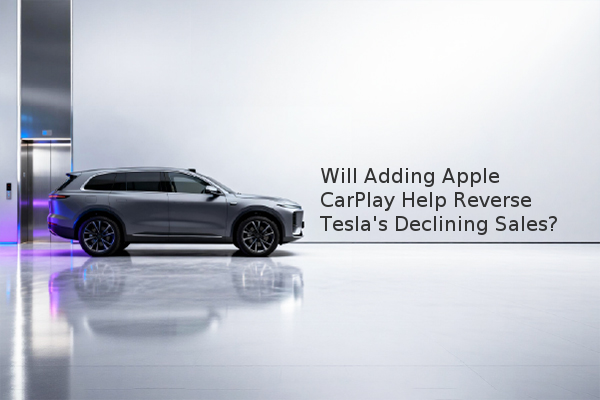
Facing slowing sales and increased competition, Tesla is reportedly planning a significant strategic shift: the integration of Apple CarPlay into its vehicles. This move, detailed in a Bloomberg report, signals a potential reversal of Tesla's long-standing reliance on its proprietary infotainment system and may be a direct response to data showing CarPlay is a critical factor for a majority of new car buyers.
Tesla's sales momentum has slowed, a trend reflected in recent quarterly earnings reports. This decline coincides with a major industry shift: the opening of Tesla's Supercharger network to competitors, which dilutes a key unique selling proposition. To counter this, Tesla appears to be addressing another frequent point of criticism—the lack of Apple CarPlay and Android Auto.
This is a surprising pivot given CEO Elon Musk's past criticism of Apple. However, it underscores the urgency Tesla feels. The decision is heavily supported by market research. Data from J.D. Power indicates that Apple CarPlay remains a top feature influencing purchase decisions. Nearly 90% of car shoppers consider smartphone integration systems like CarPlay essential, making its absence in Tesla vehicles a potential deal-breaker for a significant segment of the market.
Ironically, Tesla's move comes as other automakers, including General Motors (GM) and Rivian, are moving away from CarPlay. These companies are betting on their own proprietary, software-defined vehicle platforms. A software-defined vehicle (SDV) is one whose features and functions are primarily driven by software, often enabling updates and new services long after the car is purchased.
GM and Rivian's strategy is centered on owning the customer relationship and data to drive future subscription revenue. By integrating CarPlay, Tesla can directly appeal to buyers who are skeptical of or frustrated by this trend. Tesla could effectively position itself as the consumer-friendly alternative for tech-savvy buyers who prefer the seamless, familiar interface of their smartphones over an automaker's closed ecosystem. This could attract customers who might otherwise consider brands like GM or Rivian.
According to the Bloomberg report, Tesla's implementation of CarPlay would not be a full-screen takeover as seen in most other cars. Instead, it would likely operate "in a window inside its broader interface." This approach allows Tesla to maintain control over its core system while granting access to Apple's ecosystem.
There are also inherent safety limitations. CarPlay would not have access to core vehicle dynamics or driver-assistance features like Tesla's controversial Full-Self Driving (FSD) package. This separation is a standard safety practice, ensuring that the smartphone projection system cannot interfere with critical vehicle controls. For users, this means a familiar CarPlay experience for navigation, media, and messaging, but within the distinctive framework of Tesla's central touchscreen.
While adding CarPlay addresses a notable consumer demand, it is not a silver bullet. The primary challenges facing Tesla—increased competition across all price points, particularly in the electric vehicle (EV) market, and the aging designs of its high-volume models—remain.
However, based on our assessment of market trends, this move is a low-risk, high-potential reward strategy. It eliminates a significant competitive disadvantage at a relatively low engineering cost. By aligning with widespread consumer preference, Tesla has an opportunity to improve customer satisfaction and potentially convert buyers for whom smartphone integration is a non-negotiable feature.
For potential buyers, the reported addition of CarPlay makes a Tesla vehicle a more compelling proposition, especially if you are deeply invested in the Apple ecosystem. It reduces the learning curve of the infotainment system and provides a trusted interface for daily tasks. However, it is crucial to manage expectations regarding the implementation, as it will not be a full-screen experience and will not control vehicle-driving functions.