Browse

Log in / Register
 Share

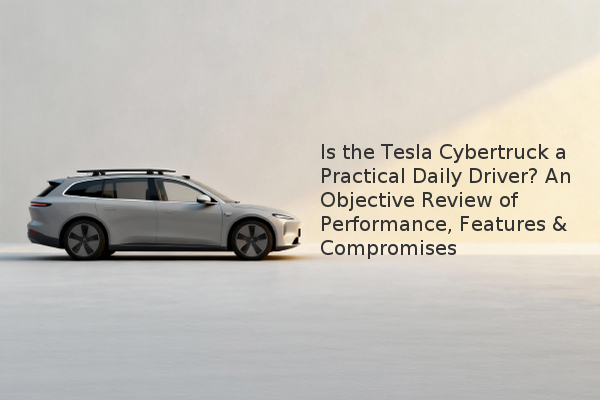
The 2025 Tesla Cybertruck is an unparalleled head-turner with staggering performance, but its polarizing design leads to significant compromises in practicality, visibility, and ease-of-use compared to conventional electric pickups like the Ford F-150 Lightning and Chevrolet Silverado EV.
The Cybertruck launched as a 2024 model and is now available as a 2025 vehicle with an expanded lineup. For this review, we tested the 2025 Cybertruck All-Wheel Drive (AWD). Its key specifications are outlined below for quick comparison.
| Feature | 2025 Cybertruck AWD Specification |
|---|---|
| Powertrain | Dual electric motor, All-Wheel Drive |
| Horsepower | 600 hp |
| 0-60 mph Acceleration | Estimated 4.1 seconds |
| Starting Price | $79,990 (plus $1,995 destination fee) |
| As-Tested Price | $85,485 (incl. options) |
The base model now includes a new Rear-Wheel-Drive (RWD) variant, while the top-tier tri-motor Cyberbeast version produces 845 horsepower. Our assessment focuses on the real-world experience of using the AWD model as an everyday vehicle.
The Cybertruck’s cabin is a study in futuristic minimalism, prioritizing a stark, tech-forward aesthetic over traditional luxury. Front-seat space is generous, with excellent headroom thanks to a roofline that peaks above the occupants. However, the rear-seat space is disappointing for a full-size pickup. The dramatically sloping roof cuts into headroom for taller passengers, and legroom is less expansive than in rivals like the Ford F-150 Lightning. The interior build quality is decent but lacks the plush materials expected at its $80,000-plus price point.
A notable feature is the rear-seat touchscreen for climate and entertainment control. A significant drawback is the standard expansive glass roof, which, despite tinting, allows substantial heat buildup on sunny days. Tesla offers a $115 sunshade to mitigate this. Storage for small items is adequate but falls short of the clever, abundant solutions found in most domestic pickup trucks.
The functionality of a pickup truck is measured by its cargo bed, and here the Cybertruck's form creates challenges. The bed itself is a respectably sized 6x4 feet, and it includes a handy under-bed trunk (similar to a Honda Ridgeline) and a clever power-retractable tonneau cover.
However, the angled body sides make accessing the front of the bed difficult. The truck’s stubby nose also results in a frunk (front trunk) that is notably smaller than those found in competing electric pickups. Based on our assessment experience, the Cybertruck's cargo solutions are innovative but less practical for heavy, frequent hauling compared to a conventional pickup.
The Cybertruck demands a complete recalibration of driving habits, primarily due to three unconventional systems: steering, shifting, and visibility.
On the move, the Cybertruck's performance is a mix of brilliance and annoyance. The acceleration is instantaneous and brutally quick, as expected from a high-performance EV. The ride is firm but composed, and the standard rear-wheel steering provides a tight turning circle for its size.
However, it is not as quiet as many electric vehicles. We noted steering column creaks, a low-speed gear whine, tire roar, and some wind noise. The one-pedal driving mode is strong and intuitive, but combined with the sensitive steering, it can make low-speed maneuvering less than smooth.
Based on our assessment experience with the Full Self-Driving (Supervised) system on a highway trip, the system performed adequately in well-marked conditions but showed significant limitations. Positives included competent automatic parking. However, the system exhibited hesitation at intersections, occasionally misread lane markings, and deactivated abruptly on unmarked rural roads. It also lacked agility in responding to sudden obstacles, requiring driver intervention.
The Tesla Cybertruck is less a utilitarian pickup and more a rolling statement piece. Its appeal is rooted in spectacle and technology.
For most truck buyers seeking a practical, capable electric vehicle, conventional options like the Ford F-150 Lightning or Chevrolet Silverado EV offer greater functionality, space, and ease of use at a lower price point.
The Cybertruck’s numerous design quirks result in real-world compromises that become apparent after the initial novelty wears off. If you prioritize head-turning style and blistering acceleration above all else, the Cybertruck is in a class of its own. If you need a pickup truck that seamlessly integrates into daily life and work, the competition is far more compelling.