Browse

Log in / Register
 Share
Share
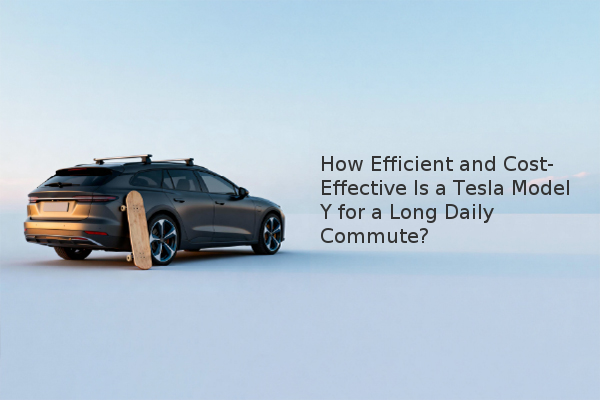
Based on our assessment experience, a Tesla Model Y proves to be a highly efficient and cost-effective vehicle for a long daily commute, achieving up to 107% of its EPA-rated range with a total cost of just 3 cents per mile when charged at home.
For many professionals, the daily commute is a necessary grind. The key to making it tolerable is a vehicle that is efficient, comfortable, and affordable to operate. After a dedicated week of commuting totaling 305 miles in a Tesla Model Y, we gathered concrete data on its real-world efficiency, charging costs, and day-to-day livability to answer a critical question for potential EV buyers.
The Model Y demonstrated impressive efficiency, averaging 227 watt-hours per mile (Wh/mi) over 305 miles of mixed city and highway driving. This equates to 4.4 miles per kilowatt-hour (kWh), achieving 95% of its official 326-mile EPA range estimate. In optimal conditions, one commute leg even exceeded the EPA rating, returning a 107.3% range efficiency.
To understand these figures, it's helpful to know that watt-hours per mile (Wh/mi) is the electric vehicle equivalent of miles per gallon (mpg) in a gasoline car; a lower number indicates higher efficiency. Several factors contributed to these results:
The data shows that efficiency varied with conditions. The most efficient commute (201 Wh/mi) occurred with an average speed of 31 mph in 47.5°F weather. The least efficient (250 Wh/mi) happened at a higher average speed of 47 mph in colder 37.1°F weather, highlighting how speed and ambient temperature are critical variables for EV range.
The total cost to drive 305 miles was $19.52, with home charging costing a remarkably low 3 cents per mile compared to public charging at 13 cents per mile.
The vast majority of charging was done at home, which is the most economical way to own an EV. Here's a cost breakdown:
| Charging Location | Cost | Estimated Range Added | Cost per Mile |
|---|---|---|---|
| Home (Level 2) | $7.32 | 222 miles | $0.03 |
| Public (Level 2) | $12.20 | 93 miles | $0.13 |
This cost advantage is significant when compared to a gasoline-powered rival. A similarly sized luxury SUV like the 2024 BMW X4 xDrive30i (rated at 24 mpg) would cost approximately 18 cents per mile using premium fuel. This demonstrates that while public charging is more expensive, home charging provides substantial savings.
While the Model Y excels in efficiency and cost, our experience revealed drawbacks in its semi-autonomous driving features and ride quality, especially on rough city roads.
The Model Y comes standard with Autopilot, which includes Autosteer (lane-centering) and Traight-Aware Cruise Control (adaptive cruise control). These systems worked flawlessly, providing reliable assistance in stop-and-go traffic. However, the optional Full Self-Driving (FSD) package was less impressive in heavy traffic, exhibiting erratic lane-change decisions that felt unsettling.
Another key finding was the ride quality. After 22,000 miles, our 2021 Model Y's suspension felt annoyingly harsh on uneven pavement, a notable downside for daily commuters. It is worth noting that Tesla introduced revised suspension tuning for the Model Y starting with the 2022 model year, which may address this issue.
A temporary but frequent annoyance was the front-facing cameras being blinded by direct sunrise, which temporarily disabled the Autopilot features until the cameras could see clearly again.
For commuters with access to home charging, the Tesla Model Y presents a compelling case due to its exceptional efficiency and low operating costs. However, its value is tempered by a firm ride and the questionable utility of its premium Full Self-Driving system in heavy traffic.
Based on our assessment, here are the key takeaways for a potential buyer: