Browse

Log in / Register
 Share
Share
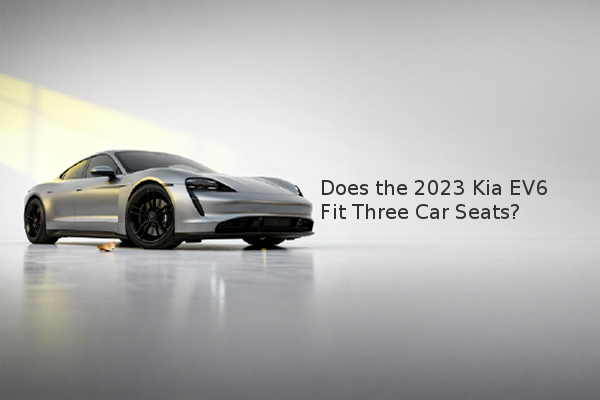
No, the 2023 Kia EV6 does not accommodate three car seats simultaneously. Based on our assessment experience, while the EV6 earns top marks for installing one or two child safety seats with its accessible Latch system, its layout prevents a secure and practical fit for three. This article provides a detailed breakdown of the EV6’s car seat compatibility, grading each configuration to help families make an informed decision.
The Latch (Lower Anchors and Tethers for Children) system is a standardized set of anchors in vehicles designed to simplify and secure child safety seat installation without relying solely on seat belts.
In the 2023 Kia EV6, the Latch system earns an A grade. The two sets of lower anchors are positioned clearly within the seat bight (where the bottom and back cushions meet) and are straightforward to access. For forward-facing seats, three top tether anchors are located mid-way down the seatbacks, all of which are well-marked and simple to connect. This ease of use is a significant advantage for parents who frequently install and remove car seats.
Our evaluation uses a 6-foot driver and a 5-foot-6-inch front passenger setup, testing a variety of seat types in the second row. The grading scale ranges from A (excellent) to F (unsafe).
Infant Car Seat (Rear-Facing): A Grade The Chicco KeyFit 30 infant seat was easy to install securely. More importantly, the front passenger still had ample legroom after installation, ensuring comfort for adults on longer journeys.
Rear-Facing Convertible Car Seat: A Grade Similar to the infant seat, installing a Graco Contender 65 rear-facing convertible seat was straightforward. There were no issues with fit, and front passenger legroom remained generous.
Forward-Facing Convertible Car Seat: A Grade After raising the head restraint, the forward-facing convertible seat fit perfectly and installed without difficulty. The process was intuitive and resulted in a secure fit.
Booster Seat: A Grade With the head restraint raised, the Graco TurboBooster sat flush against the seatback. A key feature for children is that the seat belt buckles are on stable, flipper-style bases, which can be angled upward to make it easier for a child to buckle themselves in safely.
The primary limitation is the vehicle’s physical architecture. When attempting to install three car seats across the second row—specifically, a forward-facing convertible in the center with a booster and an infant seat on the outboard sides—the configuration becomes impractical. The contours of the seats and the positioning of the seat belt buckles prevent a proper and safe fit for all three. A child in the booster seat would likely struggle to reach the center seat belt buckle, a critical safety and usability concern.
Beyond the fit, it's crucial to remember key safety guidelines. Parents have the option to use either the Latch system or the vehicle's seat belt to install a car seat; both are equally safe when used correctly. However, Latch anchors have a combined weight limit of 65 pounds, which includes the weight of both the child and the car seat itself. Once this limit is exceeded, you must switch to using the seat belt for installation.
For families with one or two children, the 2023 Kia EV6 is an excellent choice, offering easy installation and minimal impact on passenger space. However, for those requiring three car seats, the vehicle's design presents a significant limitation. The key takeaways are the accessible Latch system, the top grades for individual seat installations, and the clear two-car-seat maximum for this particular five-seat electric SUV.